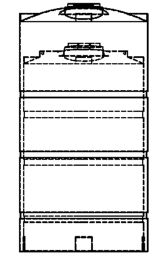
Secondary containment tanks are a primary focus of our business. We have a wide array of polyethelyne plastic containment solutions. Variations include round or rectangular, open or closed top, partial or totally encapsulated containment units.
When making decisions about spill containment, you should give careful consideration to the particular application as well as the physical space it will inhabit. Depending on your industry and application, your secondary containment tank must be large enough to handle 10% or 15% more volume than the primary container.
Our containment options fall into three basic categories: open top containment, closed double sided/single top tanks and fully encapsulated (double wall/double top) containment.
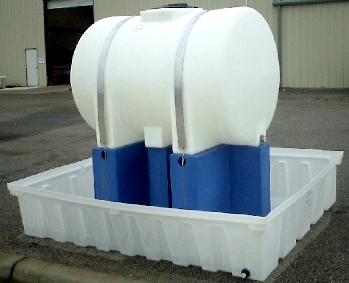
The most commonly used type of containment is the "Open Top Containment". The photo on the left shows a 225 gallon horizontal leg tank on a 32" tall polyethylene stand. The tank unit is in a 300 gallon open top rectangular containment tank. This combination is shown with optional stainless steel tie-downs and 1" polypropelyne bulkheads in the primary tank and the containment tank.
This type of containment provides easy access to the primary tank. The polypropylene is UV stabilized to give longer life to the tank.
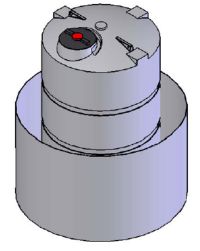
The drawing on the right shows another example ofOpen Top Containment. This shows a cylindrical open top containment tank. It allows easy access to the primary containment tank. This style gives good containment at a reasonable price.
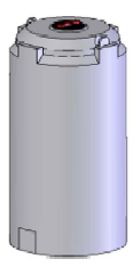
The drawing on the left shows a "Closed Vertical Containment Tank". It features dual walls and a single top. This style of containment gives easy access to the contents of the primary tank while still giving excellent containment in the case of a spill.
The maximum in secondary containment styles is the"Completely Encapsulated Containment Tank". This style features a double wall and double top. Access to the primary storage tank is more difficult with this style but the degree of protection in the event of a spill is greatly enhanced.